


Shopping Cart
Remove All Your shopping cart is currently empty


Synonyms:
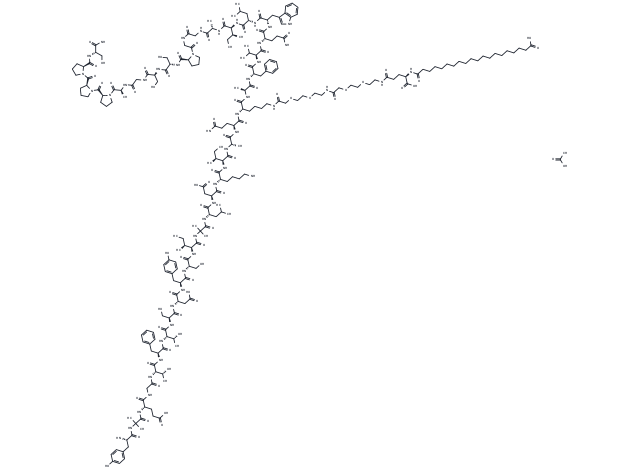
| Pack Size | Price | USA Stock | Global Stock | Quantity |
|---|---|---|---|---|
| 1 mg | $358 | In Stock | In Stock | |
| 5 mg | $798 | In Stock | In Stock | |
| 10 mg | Inquiry | In Stock | In Stock | |
| 25 mg | Inquiry | In Stock | In Stock |
| Description | Tirzepatide (LY3298176) Acetate (2023788-19-2 free base) is a new molecule that can control blood glucose levels by combining dual agonism of glucose-dependent insulinotropic polypeptide (GIP) and glucagon-like peptide-1 (GLP-1) receptors.[3] |
| Targets & IC50 | GIPR:0.0224 nM (EC50), GLP1 receptor:0.934 nM (EC50) |
| In vitro | METHODS: Tirzepatide (LY3298176) (1, 3, 10, 30 nM) was used to treat GIPR or GLP-1R receptors, and Tirzepatide (30 μM, 30 nM) was used to treat cells expressing recombinant GIPR or GLP-1R to investigate whether it is effective on both GIPR and GLP-1R. RESULTS In receptor binding studies, LY3298176 had high affinity to either receptor (GIPR Ki = 0.135, SEM = 0.020 nM; GLP-1R Ki = 4.23, SEM = 0.23 nM); for GIPR, the affinity was comparable to that of native GIP, while for GLP-1R, the affinity was approximately 5-fold weaker than that of native GLP-1. In signaling studies using the same HER2 receptors, LY3298176 potently stimulated cAMP accumulation at either receptor (GIPR EC50 = 0.0224, SEM = 0.0053 nM; GLP-1R EC50 = 0.934, SEM = 0.068 nM).[1] METHODS: Representative confocal images of Tirzepatide (LY3298176)-induced receptor internalization and EGFP fluorescence in HA-GIPR-EGFP cells treated with Tirzepatide (LY3298176) (100 nM). RESULTS Tirzepatide (LY3298176) was weak in inducing internalization, resulting in a maximal effect of only 40% of that observed with GLP-1. Treatment with Tirzepatide (LY3298176) resulted in minimal reduction in cell surface labeling and only a slight increase in punctate localization of the receptor in the cytoplasmic/perinuclear region. [2] |
| In vivo | METHODS: Tirzepatide (LY3298176) (30nmol/kg,i.p) was used to evaluate in vivo glycemic control using an intraperitoneal glucose tolerance test (ipGTT) in normal and receptor-deficient mice. RESULTS Tirzepatide (LY3298176) enhanced insulin secretion in three pancreatic islet genotypes. Tirzepatide (LY3298176) can induce glucose-dependent insulin secretion in vivo through GIPR or GLP-1R and improve glucose tolerance in mice. [1] |
| Molecular Weight | 4873.5 |
| Formula | C227H352N48O70 |
| Smiles | C[C@H]([C@@H](C(N[C@H](C(N[C@H](C(N[C@H](C(N[C@H](C(N[C@H](C(N[C@H](C(N[C@H](C(NC(C)(C(N[C@H](C(N[C@H](C(N[C@H](C(N[C@H](C(N[C@H](C(N[C@H](C(N[C@H](C(N[C@H](C(N[C@H](C(N[C@H](C(N[C@H](C(N[C@H](C(N[C@H](C(N[C@H](C(N[C@H](C(NCC(NCC(N1CCC[C@H]1C(N[C@H](C(N[C@H](C(NCC(N[C@H](C(N2CCC[C@H]2C(N3CCC[C@H]3C(N4CCC[C@H]4C(N[C@H](C(N)=O)CO)=O)=O)=O)=O)C)=O)=O)CO)=O)CO)=O)=O)=O)=O)C)=O)[C@H](CC)C)=O)CC(C)C)=O)CC5=CNC6=C5C=CC=C6)=O)CCC(N)=O)=O)C(C)C)=O)CC7=CC=CC=C7)=O)C)=O)CCCCNC(COCCOCCNC(COCCOCCNC(CC[C@H](C(O)=O)NC(CCCCCCCCCCCCCCCCCCC(O)=O)=O)=O)=O)=O)=O)CCC(N)=O)=O)C)=O)[C@H](CC)C)=O)CCCCN)=O)CC(O)=O)=O)CC(C)C)=O)C)=O)[C@H](CC)C)=O)CO)=O)CC8=CC=C(O)C=C8)=O)CC(O)=O)=O)CO)=O)[C@H](O)C)=O)CC9=CC=CC=C9)=O)NC(CNC([C@@H](NC(C(C)(NC([C@H](CC%10=CC=C(O)C=C%10)N)=O)C)=O)CCC(O)=O)=O)=O)O.CC(O)=O |
| Relative Density. | no data available |
| Sequence | Tyr-{Aib}-Glu-Gly-Thr-Phe-Thr-Ser-Asp-Tyr-Ser-Ile-{Aib}-Leu-Asp-Lys-Ile-Ala-Gln-{Lys(AEEA-AEEA-γGlu-C20 diacid)}-Ala-Phe-Val-Gln-Trp-Leu-Ile-Ala-Gly-Gly-Pro-Ser-Ser-Gly-Ala-Pro-Pro-Pro-Ser-NH₂ |
| Sequence Short | YXEGTFTSDYSIXLDKIAQKAFVQWLIAGGPSSGAPPPS |
| Storage | Keep away from moisture Powder: -20°C for 3 years | In solvent: -80°C for 1 year Shipping with blue ice/Shipping at ambient temperature. | ||||||||||||||||||||||||||||||
| Solubility Information | DMSO: 245 mg/mL (50.27 mM), Sonication is recommended.  H2O: < 1 mg/mL (insoluble or slightly soluble) | ||||||||||||||||||||||||||||||
Solution Preparation Table | |||||||||||||||||||||||||||||||
DMSO
Note : The dilution table applies only to solid products. For liquid products, please calculate the stock solution based on the stated concentration and/or density. | |||||||||||||||||||||||||||||||
 For example, if the intended dosage is 10 mg/kg for animals weighing 20 g , with a dosing volume of 100 μL per animal, and a total of 10 animals are to be administered, using a formulation of
  10% DMSO+ 40% PEG300+ 5% Tween 80+ 45% Saline/PBS/ddH2O , the resulting working solution concentration would be 2 mg/mL.
Dissolve 2 mg of the compound in 100 μL DMSO to obtain a stock solution at a concentration of 20 mg/mL . If the required concentration exceeds the compound's known solubility, please contact us for technical support before proceeding.
1) Add 100 μL of the DMSO stock solution to 400 µL PEG300 and mix thoroughly until the solution becomes clear.
2) Add 50 µL Tween 80 and mix well until fully clarified.
3) Add 450 µL Saline,PBS or ddH2O and mix thoroughly until a homogeneous solution is obtained.
| Size | Quantity | Unit Price | Amount | Operation |
|---|
 Feedback
 Hello! How can I help you today?
Copyright © 2015-2026 TargetMol Chemicals Inc. All Rights Reserved.
